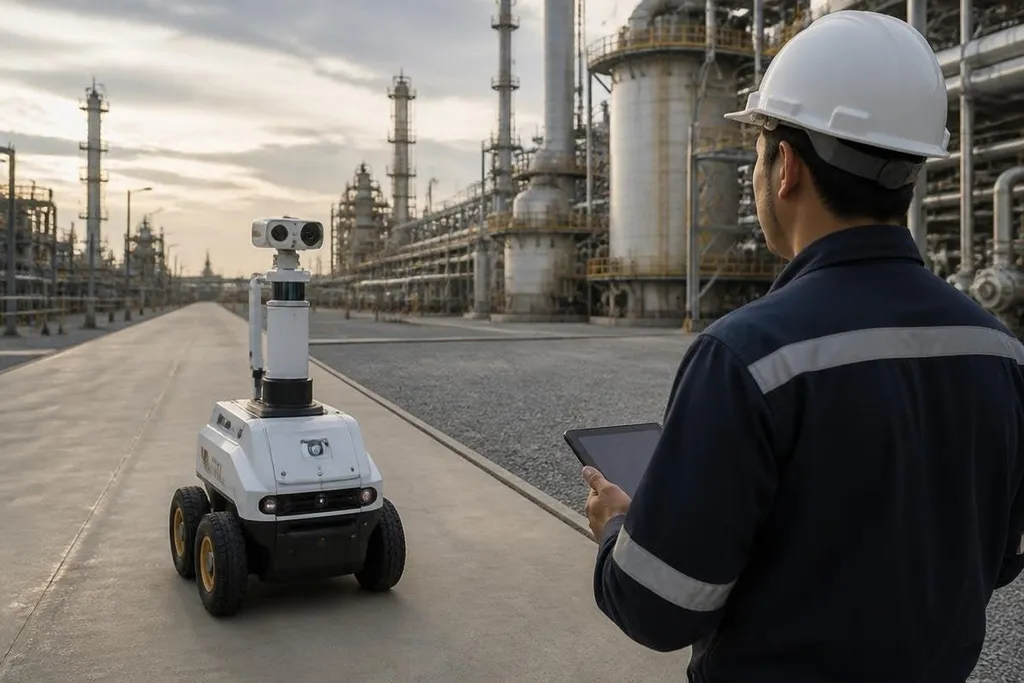
A patrol robot can watch a camera feed for hours, but that does not tell an operator what deserves attention. AI adds software that can sort images, spot changes, and flag events while the robot keeps moving through a site.
This matters when one person must watch a large plant, yard, or restricted area. It still needs sensors, power, safe routes, and a human who can check its warnings.
Quick read
- AI can sort video, thermal images, and sound into useful alerts.
- LiDAR and cameras help the robot map its route and notice changes.
- Human review remains needed when an alert could lead to action.
What AI adds to a patrol robot
A surveillance robot collects more than ordinary video. A camera records visible light, a thermal sensor shows heat, a microphone can detect sound, and LiDAR measures distance with laser pulses.
AI software compares those inputs with rules set for the site. That software can flag a person in a closed area, a vehicle outside an approved route, smoke near equipment, or an object that was not present during an earlier patrol. The exact alert list depends on the sensors and the model used, so a camera-only robot cannot make the same checks as one with thermal sensing.
It then sends an alert with a time, location, sensor view, and event type. This gives the operator a starting point instead of a full video feed to watch from beginning to end.
How the robot makes decisions
Many systems split the work between the robot and a remote computer. A small computer on the robot can sort urgent sensor data before sending it over a wireless network. A larger server can run heavier image models when the connection and site rules allow it.
This split matters in places with weak network coverage. Even with the link down, it may still detect a person or stop at a blocked route, but the operator may receive the alert later. Site managers should ask which functions keep running without a connection.
AI can also support mapping. Simultaneous localization and mapping, or SLAM, lets a robot build a map while estimating its position on that map. Cameras and LiDAR can work together, though dust, rain, glare, and blocked views can reduce the quality of the result.
Dust or glare can leave a surveillance robot with a map it cannot safely trust. Robot24.com robotics reporting can tie an AI claim to the sensors, test setting, and human control behind it before the next section examines where the system can fail.
Where the system can fail
An alert is a software result, not proof that an event happened. A thermal camera may see a warm machine part as a person. A shadow can look like movement. A new box may trigger an object-change rule even when nothing is wrong.
Poor site data can create more trouble. If the system learns from clear daytime images, it may perform worse at night or during rain. A model trained for one type of fence, floor, or vehicle may also misread another site.
Privacy creates a second limit. A company needs clear rules for video storage, access, retention, and deletion. It also needs a way to review false alerts and correct the system when its results cause repeated errors.
I'd choose a robot with fewer alert types and clear evidence over one that makes broad claims about understanding every event.
A buying checklist
Before a pilot, check these points:
- Name the event: Write down the exact alert the robot must find, such as a person inside a closed zone.
- Match the sensor: Add thermal sensing for heat-based checks or LiDAR for distance and route data.
- Test the link: Walk the robot through weak-network areas and record which functions keep running.
- Set human review: Decide who checks an alert before security, maintenance, or emergency staff act.
- Measure false alerts: Count incorrect warnings during day, night, rain, and normal site work.
A useful pilot should answer one narrow question with recorded results. It should show the alert count, missed events, response time, battery use, and the work needed to correct errors.
The next purchase decision should rest on that log, not on a polished patrol video. If the robot cannot show why it raised an alert and where the sensor data came from, the AI is adding another screen rather than useful surveillance.